
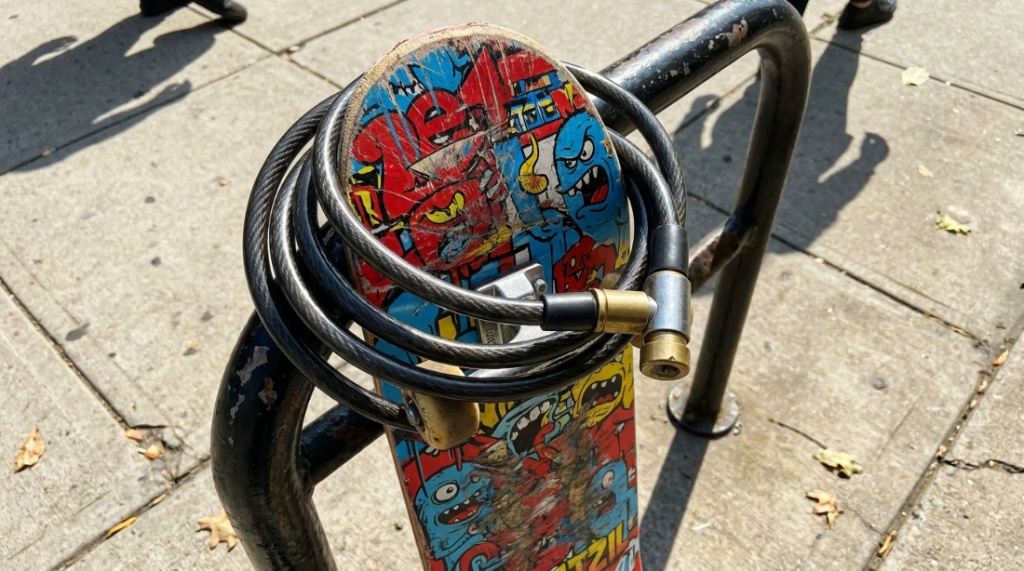
You step out of a coffee shop, a library, or a class, and your board is gone. For riders in California, that scenario is common because boards are light, valuable, and easy to grab. A good lock changes the math: it makes your board slow and awkward to steal, so a thief moves on to an easier target. This guide explains how skateboard locks actually work, what to look for, and how to secure your board in real California settings, from campus racks to beach boardwalks.
Key Takeaways
- No skateboard lock makes a board theft-proof. The goal is to make theft slow, loud, or inconvenient enough that a thief gives up.
- U-locks and heavy chain locks offer the most resistance; cable and zip-style locks work best as quick deterrents for short stops.
- Lock through the trucks or a truck baseplate hole, never through the deck, wheels, or bearings.
- Public racks, bike corrals, and well-lit high-traffic spots are far safer than hidden corners, even with a strong lock.
- A lock only helps if you actually carry it, so portability matters as much as security rating.
How Skateboard Locks Actually Work
A skateboard lock does not secure the whole board like a bike lock secures a frame and both wheels. Instead, it connects one solid part of your board, usually a truck or the deck near a truck, to a fixed object. If a thief cannot quietly detach that point, they have to cut the lock, break the object you locked to, or damage the board to take it. Those are the three failure points to think about.
This is why lock choice is only one part of the equation. The anchor point matters just as much. Locking your board to a thin signpost, a loose fence rail, or a plastic rack gives a thief an easy shortcut. Locking to a thick steel bike rack or a concrete-embedded post removes that shortcut.
What a Lock Can and Cannot Do
A lock can stop an opportunistic thief who spots your board and acts in seconds. It can also slow a determined thief long enough that witnesses, cameras, or your return make the risk not worth it. What it cannot do is make your board untouchable. Anyone with a cordless angle grinder or bolt cutters and enough privacy can defeat most locks. Treat your lock as a delay device and a deterrent, not a guarantee.
That is also why insurance and registration matter for expensive completes. If your board is worth several hundred dollars, a lock plus a record of the serial number and photos gives you options a lock alone does not.
Choosing the Right Lock Type for Your Riding Style
The best lock for you depends on how long you leave your board, where you leave it, and how much weight you are willing to carry. Here is how the main categories compare for real-world use.
| Lock Type | Security Level | Portability | Best Use Case |
|---|---|---|---|
| Heavy chain lock | High | Low (bulky, heavy) | All-day parking on campus or at work |
| U-lock | High | Medium (clips to a belt or bag) | Medium to long stops in visible areas |
| Coiled cable lock | Low to medium | High (fits in a pocket) | Quick stops, coffee shops, restrooms |
| Zip-style or strap lock | Low | Very high (fits in a pocket or on the board) | Very short stops in low-risk areas |
| Combination lock with cable | Low | High | Casual riders who dislike carrying keys |
If you ride in a city like Los Angeles, San Francisco, or San Diego, where boards get stolen quickly in busy areas, lean toward a U-lock or chain lock. If you mostly cruise a boardwalk in Santa Monica or Huntington Beach, a cable lock paired with smart placement may be enough for a short break. Choosing a lock that matches your habits matters more than buying the most expensive option.
Riders comparing specific models and price ranges often start with a curated list of portable skateboard lock california riders actually use, since local conditions, from campus racks to beach paths, shape which locks hold up. The key is to match the lock to where you park, not just to a spec sheet.
How to Lock Your Board Correctly
- Pick a fixed anchor that cannot be lifted, unscrewed, or cut easily. Thick steel bike racks and embedded posts are ideal.
- Loop the lock through a truck axle, the truck baseplate hole, or the deck hole near a truck. These are the hardest spots to remove.
- Avoid locking through wheels, bearings, or the middle of the deck. Wheels pop off with a tool, and decks can be snapped or sawed.
- Keep the lock snug so there is no slack for leverage. Slack lets a thief twist or pry the lock.
- Double-check that the anchor and the board both feel secure before you walk away.
A common mistake is locking only through the deck. A determined thief can cut through a deck faster than they can cut a decent lock. Locking through a truck forces them to either cut metal or take the whole setup with the lock attached, which is much harder to hide or sell.
California-Specific Theft Risks to Know
Board theft in California tends to cluster in predictable places. Understanding those patterns helps you pick where to lock up.
Campus settings are a major risk area. University and college libraries, dining halls, and lecture halls generate long unattended windows and a steady flow of people who blend in. Thieves know this and work these areas heavily. Bike racks near entrances are often watched, so a lock that looks weak, or a board left unsecured, stands out.
Beaches and boardwalks create a different problem. Riders leave boards outside restrooms, snack stands, and surf shops, often in sandals and without pockets for a heavy lock. That combination of short stops and casual setups is exactly what opportunistic thieves target. A lightweight lock that you actually carry beats a heavy lock left at home.
Transit hubs add another layer of risk. BART, Metro, and bus stops concentrate people, but they also concentrate quick exits. A thief can grab a board and be on a train before you notice. Locking to a fixed rack while you wait, even for a few minutes, removes that option.
Event crowds, from street fairs to concerts, create the same dynamic at scale. In those settings, visibility matters. A lock that is highly visible, like a bright U-lock or chain, makes your board a less attractive target because onlookers might notice someone cutting it, To gear up for your next session safely, check out why elbow pads are essential for safe skateboarding before hitting the ramp.
Portability vs. Security: Finding the Balance
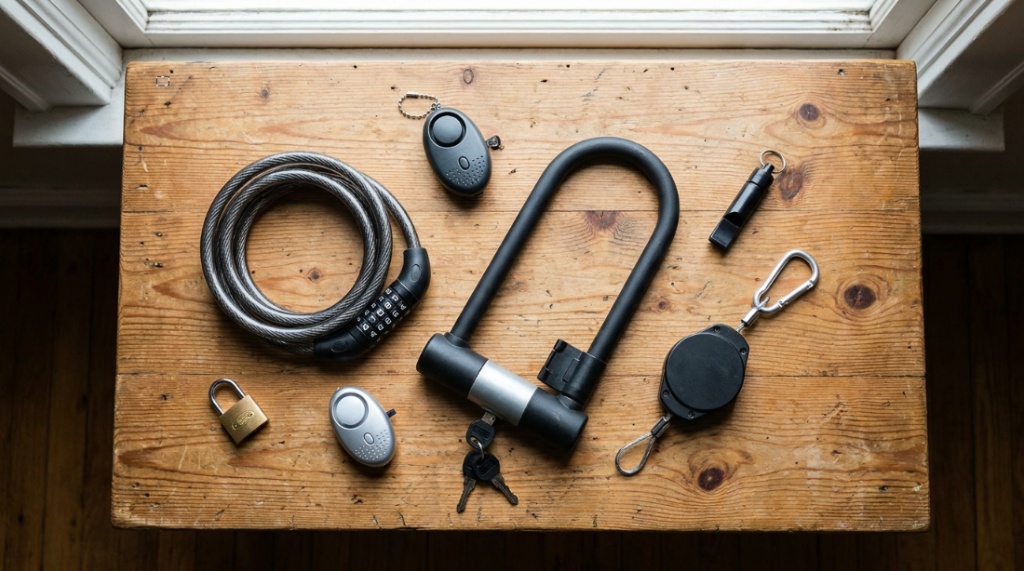
The most secure lock in the world is useless if it stays in your drawer. Riders who end up not carrying a lock usually do so because it is too heavy, too bulky, or too slow to use. That is why portability deserves real weight in your decision.
A practical approach is to own two locks. Keep a heavier U-lock or chain for predictable, longer stops like work or school, and carry a compact cable or strap lock for spontaneous stops. This two-lock strategy avoids the trap of choosing one lock that is either too weak for long stops or too heavy for daily carry.
If you only want one lock, a mid-weight U-lock is usually the best compromise. It is heavy enough to resist casual attacks and small enough to clip to a bag or belt loop. Look for a lock with a mounting bracket if you plan to carry it often, since brackets keep the lock from swinging or digging into your side.
Features Worth Paying For
- Hardened steel shackle or chain links, which resist cutting far better than soft metal.
- A locking mechanism that resists picking and drilling, not just a simple pin tumbler.
- A protective coating on the shackle to avoid scratching your trucks or deck.
- A keyed or combination system you can actually use quickly with cold or tired hands.
- A size long enough to reach around a thick rack and your truck, but not so long that it hangs loose.
Skip locks with plastic housings or thin cables if you plan to leave your board unattended for more than a few minutes. They are convenient, but they are not built to survive a determined attempt.
Smart Habits That Reduce Theft Risk
Lock choice matters, but habits matter just as much. A few simple routines cut your risk significantly.
Lock up before you go inside anywhere, even if you think you will be quick. Thefts happen in the time it takes to order a coffee. Lock in well-lit, high-traffic spots rather than around the corner where no one can see. If there is a camera nearby, use it.
Mark your board in a way that is hard to remove. A serial number, an engraving, or a distinctive sticker under the grip tape helps you prove ownership if it turns up at a pawn shop or online. Keep a photo of your setup and its serial number on your phone.
Avoid leaving your board locked overnight in public, even with a strong lock. Overnight gives a thief hours of privacy to work on the lock, and most public racks are empty and unmonitored after dark. If you must leave it, choose a spot with lighting and foot traffic, or ask a business if they can hold it inside.
Consider whether your board is worth the risk at all on certain trips. If you are going somewhere you cannot bring your board inside, a cheaper secondary board or a folding scooter may be a smarter choice than risking an expensive setup.
Frequently Asked Questions
Are skateboard locks actually worth it?
Yes, for most riders. A lock does not make your board theft-proof, but it removes the easy opportunity that most thieves rely on. Even a modest lock turns a two-second grab into a risky, time-consuming job. Pair it with smart placement and the protection improves further.
What is the best place to lock a skateboard?
Lock through a truck axle, the truck baseplate, or the deck hole near a truck. These points are the hardest to remove without tools. Avoid wheels, bearings, and the middle of the deck, since those can be taken or broken more easily.
Can a thief cut through a skateboard lock?
With the right tools and enough privacy, yes. Cordless grinders and bolt cutters can defeat most locks. That is why lock quality, anchor choice, and location all matter together. A strong lock in a visible spot is far harder to defeat than a weak lock in a hidden one.
What lock should California riders carry daily?
A mid-weight U-lock is the most common daily choice because it balances security and portability. Riders who make long stops should consider a heavier chain or U-lock, while riders making quick stops may prefer a compact cable or strap lock they will actually carry.
How long does it take to steal a locked skateboard?
It depends on the lock and tools. A weak cable or strap lock can be cut in seconds with basic tools. A hardened steel U-lock or chain generally takes longer and makes more noise, which is usually enough to deter an opportunistic thief.
Should I lock my board if I am only going inside for a minute?
Yes. Most board thefts happen during short, unguarded moments because the thief knows you will not be watching. Locking up takes a few seconds and removes that opening entirely.
Conclusion
The right lock depends on where you ride and how long you leave your board. For most California riders, a mid-weight U-lock or chain lock paired with smart placement covers the widest range of situations, while a compact cable lock handles quick stops. Always lock through a truck, choose a fixed anchor, and pick visible spots over hidden ones. Do those three things and you make your board a much less appealing target, so you can ride and park with far less worry.