
In an era where innovation drives progress, teaching students how to think critically and creatively has never been more important. Schools and educators often focus on either convergent or divergent thinking, but rarely on how to integrate both. However, to prepare students for real-world problem-solving, they must be adept at both structured analysis and free-flowing creativity.
One way to explore career development in this direction is through resources like Career Beez, which provides insights into professional growth. Understanding how to develop both thinking styles can help individuals stand out in a competitive job market.
Now, let’s examine each thinking style individually before looking at ways to integrate them seamlessly.
Understanding Convergent and Divergent Thinking

What is Convergent Thinking?
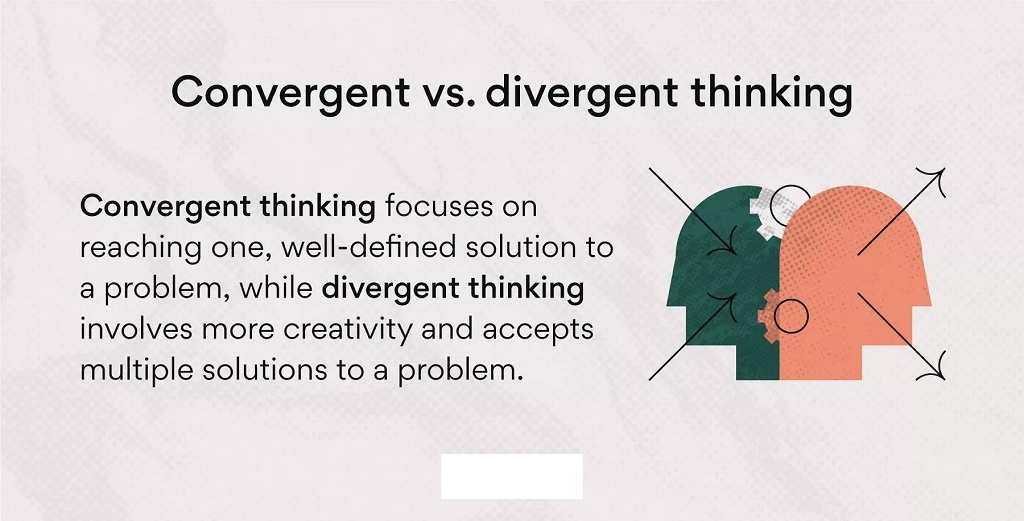
Convergent thinking is a logical, analytical approach to problem-solving where a single, correct answer is sought. This thinking style is common in standardized testing, mathematical reasoning, and scientific analysis.
Key Characteristics of Convergent Thinking
- Focuses on finding the “best” or “correct” answer
- Uses logic, patterns, and structure
- Encourages efficiency and clarity
- Typically results in a single solution
Examples of Convergent Thinking in Education
- Mathematics: Solving algebraic equations where only one correct answer exists
- Standardized Tests: Multiple-choice exams that require students to select the best response
- Science Experiments: Conducting tests that aim to prove or disprove a hypothesis
While convergent thinking is essential for structured problem-solving, relying on it alone can stifle creativity. This is where divergent thinking becomes a valuable tool.
What is Divergent Thinking?
Divergent thinking is an exploratory, open-ended approach to problem-solving where multiple solutions are considered. This style is most evident in creative fields like writing, design, and brainstorming sessions.
Key Characteristics of Divergent Thinking
- Encourages multiple solutions to a problem
- Values creativity and innovation
- Thrives on brainstorming and free association
- Emphasizes originality and flexibility
Examples of Divergent Thinking in Education
- Creative Writing: Crafting multiple story endings
- Brainstorming Sessions: Generating various marketing strategies
- Design Thinking: Developing multiple prototypes for a new product
Both thinking styles play crucial roles in learning and professional development. But the key question remains: how do we teach them together effectively?
Integrating Convergent and Divergent Thinking in Education
Understanding the Average Length of PhD and Its Thinking Demands
Many academic programs, especially PhDs, require students to master both convergent and divergent thinking. A PhD involves structured research methods (convergent thinking) alongside novel contributions to knowledge (divergent thinking). The average length of PhD varies, but regardless of duration, the ability to shift between these two thinking modes is critical.
For instance, when writing a dissertation, students must analyze existing research (convergent thinking) and propose unique theories (divergent thinking). This balance is a perfect example of why integrating both styles in education is essential.
Effective Teaching Strategies for Combining Both Thinking Styles
Project-Based Learning
One of the best ways to teach convergent and divergent thinking together is through project-based learning (PBL). PBL encourages students to explore a topic creatively while also requiring structured research and presentation.
- Example: Assign a project where students must create a business plan. They brainstorm multiple business ideas (divergent) before narrowing down the most viable one (convergent).
Socratic Questioning
Encouraging students to ask and answer deep questions fosters both thinking styles. Socratic questioning pushes students to think critically, analyze different perspectives, and generate multiple responses before concluding.
- Example: In a debate, students brainstorm different viewpoints (divergent) before presenting their final argument (convergent).
Gamification and Role-Playing
Incorporating games and role-playing activities can also merge these thinking styles.
- Example: A mystery-solving game where students brainstorm various suspect motives (divergent) before analyzing evidence to identify the culprit (convergent).
Interdisciplinary Learning
Blending subjects like science and art or math and music can create opportunities to apply both thinking styles simultaneously.
- Example: Students design a bridge (engineering and physics) while also developing aesthetic appeal (art and design).
Why Balancing Both Thinking Styles Matters
A well-rounded thinker can adapt to different challenges, making them more employable and innovative. Research by the Harvard Business Review suggests that companies that encourage both structured problem-solving and creative brainstorming outperform competitors by 30% in innovation metrics.
Additionally, psychologists such as J.P. Guilford, who coined the terms “convergent” and “divergent thinking,” emphasized that the most successful individuals know when to apply each mode of thinking.
From an educational perspective, Stanford University’s d.school integrates both thinking styles in their design-thinking approach, showing how structured and open-ended problem-solving together lead to real-world solutions.
Read More Also: Understanding the Importance of Brake Fluid Flushes for Modern Cars: The Hidden Danger You Can’t Ignore
FAQs
Why is it important to teach convergent and divergent thinking together?
Teaching both thinking styles equips students with the ability to generate ideas creatively and refine them logically, preparing them for complex real-world challenges.
What are some simple exercises to teach both thinking styles?
Activities like brainstorming sessions followed by structured decision-making, or analyzing case studies with open-ended discussions, can effectively balance both styles.
Can students develop both types of thinking equally?
Yes, with practice and the right learning environment, students can strengthen both their creative and analytical abilities.
Which professions require both convergent and divergent thinking?
Fields like medicine, engineering, business, design, and research all require a mix of structured analysis and creative problem-solving.
How do standardized tests impact thinking styles?
Most standardized tests favor convergent thinking by requiring single-answer responses, but incorporating project-based assessments can encourage both styles.
What role does technology play in fostering these thinking styles?
Educational tools like mind-mapping software, coding platforms, and AI-driven learning can enhance both analytical and creative thinking skills.
Conclusion
Teaching convergent and divergent thinking together is the key to developing well-rounded problem-solvers, innovators, and critical thinkers. By integrating project-based learning, interdisciplinary approaches, and interactive activities, educators can create an environment where students master both structured and creative problem-solving.
As the world continues to evolve, those who can think both analytically and imaginatively will thrive. Whether in education, business, or research, the ability to toggle between convergent and divergent thinking will be a defining skill of the future.