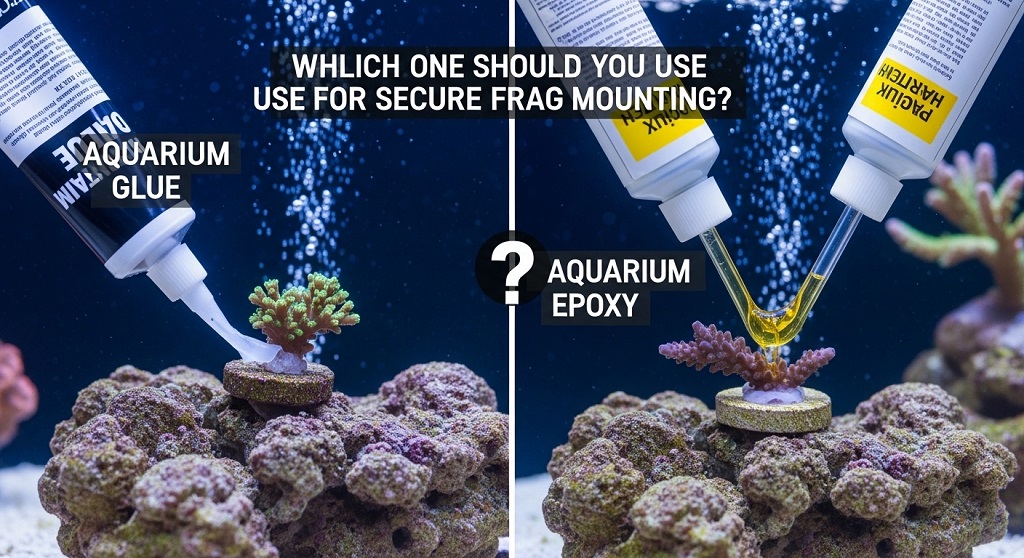
Choosing between aquarium glue vs epoxy for corals can determine whether your coral frags attach securely or fall off within days. Many reef keepers assume both products do the same job. They do not. Each works best in different conditions, coral types, and aquascaping goals.
If you mount frags incorrectly, they can shift in current, stress tissue, or fail to encrust properly. That leads to slow growth and wasted effort. The good news: selecting the right adhesive is simple once you understand how each behaves underwater.
This guide explains when to use aquarium glue, when epoxy performs better, and how experienced reef hobbyists combine both for stronger mounting. You’ll also learn practical decision rules based on coral size, tank flow, and surface type. By the end, you’ll know exactly which option works best for your reef setup.
What Is the Difference Between Aquarium Glue and Epoxy for Corals?
Short answer: Aquarium glue bonds quickly and works best for small coral frags, while epoxy provides structural support for larger or heavier corals.
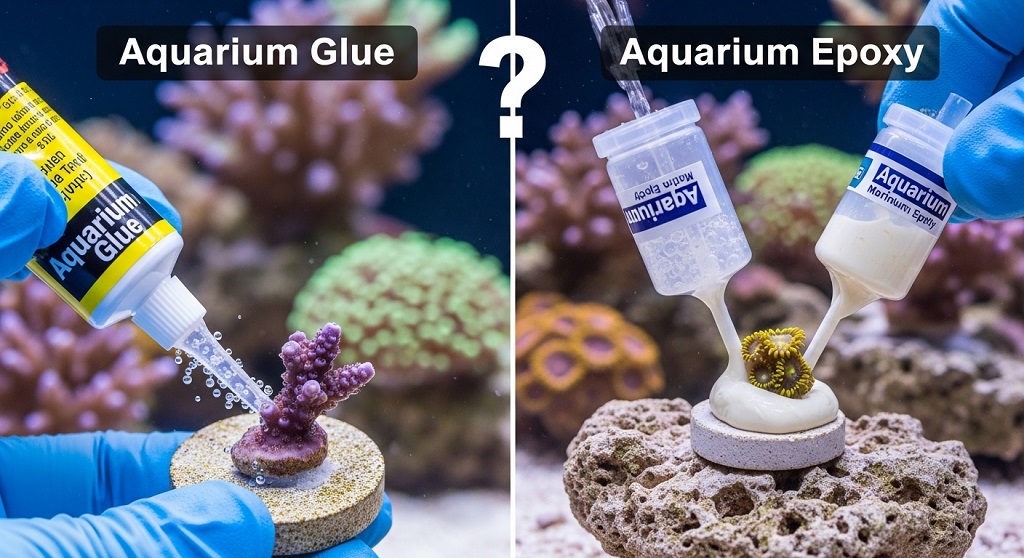
Aquarium glue is usually cyanoacrylate gel. It cures rapidly underwater and forms a tight bond between frag plugs and rock surfaces. Epoxy is a two-part putty that hardens slowly but creates a stronger mechanical hold.
Understanding their differences helps prevent loose frags and coral stress.
Key Differences at a Glance
| Feature | Aquarium Glue | Epoxy |
|---|---|---|
| Curing time | Seconds | Minutes to hours |
| Best for | Small frags | Large corals |
| Ease of use | Very easy | Moderate |
| Strength | Moderate | High structural hold |
| Water clouding risk | Low | Temporary possible |
Many reef keepers combine both adhesives to maximize stability.
When Should You Use Aquarium Glue for Corals?
Short answer: Use aquarium glue when mounting small coral frags or attaching corals to frag plugs and smooth rock surfaces.
Cyanoacrylate gel works fast. That speed makes it ideal for quick coral placement without removing rocks from the aquarium.
This matters in tanks with strong flow. A slow adhesive increases the risk of fragments shifting before bonding.
Best Situations for Aquarium Glue
- Mounting zoanthids
- Attaching SPS frags
- Fixing loose coral plugs
- Working inside filled aquariums
- Positioning lightweight coral fragments
Public reef hobbyist demonstrations, including controlled mounting trials shared by Bulk Reef Supply, show cyanoacrylate gel can secure small frags within seconds underwater. That reduces handling time and stress on coral tissue.
Because the adhesive forms a thin bonding layer, it allows faster encrusting compared to thicker mounting materials.
When Should You Use Epoxy for Corals?
Short answer: Use epoxy when stabilizing large coral pieces or securing structures that need long-term support.
Epoxy putty creates a physical anchor between rock surfaces. It works especially well when attaching corals in high-flow reef tanks.
Unlike glue, epoxy fills gaps between uneven rock textures.
Best Situations for Epoxy
- Mounting large LPS corals
- Securing branching colonies
- Stabilizing rock structures
- Supporting top-heavy coral growth
- Attaching corals to porous rock
Because epoxy takes longer to cure, it allows repositioning before final placement. That flexibility helps when adjusting coral orientation for light exposure.
Can You Use Aquarium Glue and Epoxy Together for Corals?
Short answer: Yes. Combining glue and epoxy creates one of the strongest coral mounting methods available.
Experienced reef keepers often sandwich epoxy between two layers of cyanoacrylate gel. This hybrid method improves grip and reduces curing movement.
Why the Combination Method Works
- Glue bonds instantly to coral base
- Epoxy fills structural gaps
- Outer glue layer locks placement quickly
- Bond remains stable under strong flow
This method is especially effective when attaching SPS corals to vertical reef walls.
Which Is Better for SPS Corals: Aquarium Glue or Epoxy?
Short answer: Aquarium glue is usually better for SPS corals because it bonds quickly and supports rapid encrusting.
SPS corals like Acropora and Montipora require stable mounting with minimal movement. Cyanoacrylate gel provides that stability immediately.
Because SPS corals grow outward from the base, thin adhesive layers encourage faster attachment to live rock.
Epoxy may still help when attaching large SPS colonies or mounting frags on uneven rock surfaces.
Which Is Better for LPS Corals: Aquarium Glue or Epoxy?
Short answer: Epoxy is typically better for LPS corals because it supports heavier skeleton structures.
LPS species such as Euphyllia and Favia develop thicker bases. These require stronger structural anchoring.
Epoxy distributes weight across the rock surface. That reduces tipping risk during strong water movement.
However, glue still works for smaller LPS frags.
Does Aquarium Glue Harm Corals or Reef Fish?
Short answer: Reef-safe cyanoacrylate glue does not harm corals or fish when used correctly.
Cyanoacrylate has been used in reef aquariums for decades. Once cured, it becomes inert and stable.
Short exposure during application does not damage coral tissue if contact remains minimal.
Always use reef-safe gel versions instead of liquid formulas.
Does Epoxy Affect Water Chemistry in Reef Tanks?
Short answer: Epoxy may temporarily cloud water but does not permanently affect reef chemistry.
Some hobbyists notice protein skimmers reacting strongly after epoxy placement. This is normal and temporary.
Water clarity usually returns within hours.
Using small amounts at a time reduces skimmer disruption.
How Long Does Aquarium Glue Take to Cure Underwater?
Short answer: Aquarium glue cures within seconds underwater and reaches full strength within minutes.
This rapid curing speed makes it ideal for quick frag placement in active reef systems.
However, holding the coral steady for 20–30 seconds improves bonding success.
How Long Does Epoxy Take to Cure in Reef Tanks?
Short answer: Epoxy begins hardening within minutes but may require up to 24 hours for full strength.
During early curing stages, avoid adjusting coral placement.
Movement before hardening weakens the bond.
Is Aquarium Glue or Epoxy Better for High-Flow Reef Tanks?
Short answer: A glue-and-epoxy combination works best in high-flow reef environments.
Strong circulation increases the risk of coral displacement.
The hybrid method improves resistance against shifting.
Many reef aquascapers rely on this technique when mounting corals near powerheads.
What Mistakes Should You Avoid When Mounting Corals?
Short answer: Avoid using too much adhesive, rushing placement, or selecting the wrong product for coral size.
Common mounting mistakes reduce coral survival rates.
Frequent Errors
- Using liquid instead of gel glue
- Skipping surface drying before application
- Applying excessive epoxy
- Mounting in unstable flow zones
- Handling coral tissue directly
Correct technique improves long-term coral attachment success.
How Do Experts Choose Between Aquarium Glue vs Epoxy for Corals?
Short answer: Experts choose glue for speed and precision, epoxy for structure and support.
Professional aquascapers follow a simple rule: match adhesive strength to coral weight.
Lightweight frags need fast bonding. Heavy colonies require structural reinforcement.
In large reef installations, hybrid mounting methods are considered best practice.
Conclusion: Which Should You Choose for Your Reef Tank?
Choosing between aquarium glue vs epoxy for corals depends on coral size, tank flow strength, and mounting surface texture. Small SPS frags usually perform best with cyanoacrylate gel. Larger LPS colonies benefit from epoxy support. In high-flow reef environments, combining both creates the most reliable attachment method.
The goal is simple: stabilize coral quickly while allowing natural growth and encrusting. Selecting the correct adhesive improves coral survival, placement flexibility, and long-term aquascape stability.
If you want stronger coral placement results, start testing the glue-and-epoxy hybrid method in your next fragging session. It remains one of the most trusted techniques used by experienced reef keepers worldwide.
Try the method in your next aquascaping adjustment and observe how much more secure your coral mounts become.
Frequently Asked Questions About Aquarium Glue vs Epoxy for Corals
Can I use super glue instead of aquarium glue for corals?
Yes. Cyanoacrylate gel super glue is reef safe once cured. Always choose gel versions instead of liquid formulas for better control.
Will epoxy stop coral growth?
No. Epoxy does not stop coral growth. However, applying too much around the coral base may slow initial encrusting.
Is it safe to glue corals underwater?
Yes. Aquarium glue is designed for underwater use and cures instantly when exposed to moisture.
Why does epoxy make my protein skimmer overflow?
Epoxy temporarily alters surface tension in aquarium water. This causes short-term skimmer overreaction that usually resolves within hours.
Can I reposition coral after using aquarium glue?
Only briefly. Glue bonds quickly, so repositioning becomes difficult after initial placement.
Do I need to remove rocks before applying epoxy?
No. Most reef-safe epoxy putties are designed for underwater application and do not require rock removal.
Read More Also: How to Choose the Best Nursing Pillow for Feeding Twins
Learn More: How to Find Forgiving Golf Irons for High Handicappers